
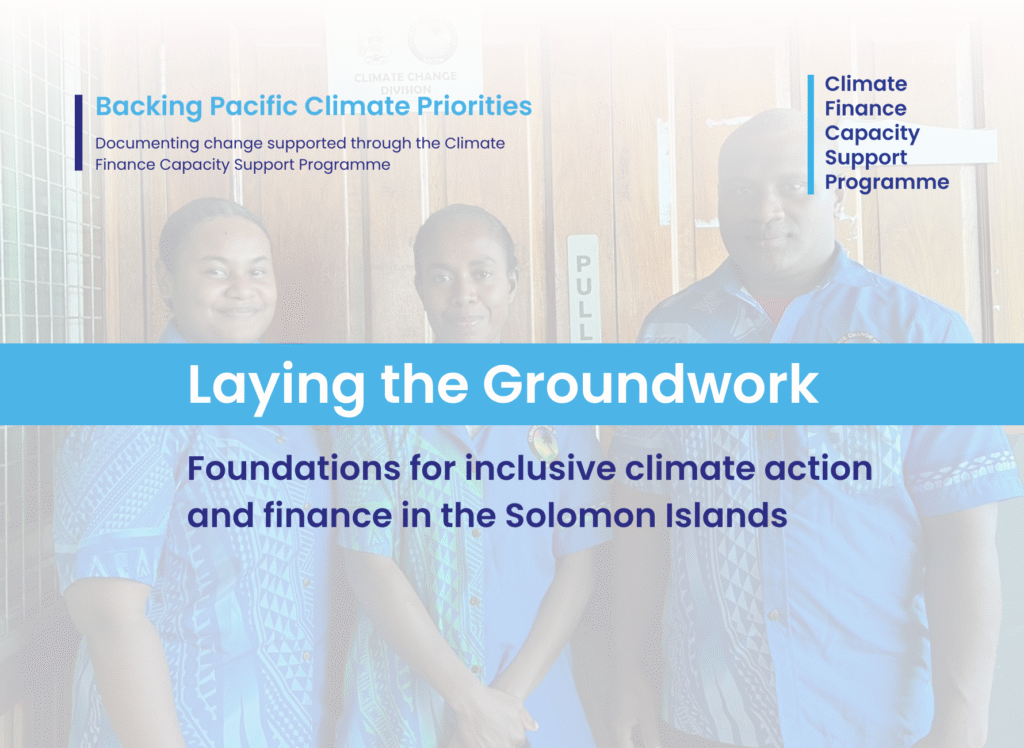
May 2025
It’s still early days, but this is a fresh start for us. We’re looking forward to the months to come, when the work really picks up.
— Thaddeus Siota, Director, Climate Change Division
Summary Statement
In the Solomon Islands, early signs of progress are emerging through the mobilisation of embedded climate change professionals under the Climate Finance Capacity Support Programme (CFCSP). While the work remains in its initial stages, key foundations are being established across data systems, policy development and climate finance coordination. The placement of 2 Solomon Islands Integrated Vulnerability Assessment (SIIVA) Officers, a Monitoring, Reporting and Verification (MRV) Officer within Ministry of Environment, Climate Change (MECC), a Gender Consultant and, most recently, a Principal Climate Finance Resilience Officer within the Ministry of Finance and Treasury, has begun to fill longstanding gaps in technical capacity.
These efforts are directly aligned with the CFCSP Theory of Action for the Solomon Islands which prioritises improved institutional capacity, stronger planning and delivery systems, inclusive stakeholder engagement and more coordinated climate finance governance. Collectively, they reflect a growing foundation from which more structured, inclusive and resilient climate action can emerge.
Context and Challenge
The Solomon Islands faces severe climate risks, including raising temperatures, changing rainfall patterns, extreme weather events, and sea level rise. To address these risks, the ‘National Climate Change Policy 2023–2032’ highlights the need for evidence-informed, inclusive and coordinated action. However, implementation has been slower than expected due to decentralised governance systems, capacity gaps in risk assessment and inconsistent gender and inclusion practices. To address these implementation challenges, the Solomon Islands Government will work to progress the development of a Climate Change Bill as the over-arching governance mechanism.
The CFCSP responded to these challenges by embedding 3 technical roles within the Climate Change Division (CCD), with a focus on establishing assessment systems (integrated vulnerability assessment and monitoring, reporting and verification) that will support access to national and international climate finance systems. In response to identified gaps in inclusive infrastructure planning, the CFCSP is supporting the National Transport Fund (NTF) through an embedded Gender Consultant who is finalising the Fund’s Gender Equality, Disability and Social Inclusion (GEDSI) Policy and assisting with pre-accreditation requirements for the Green Climate Fund.
Laying the Groundwork
Strengthening vulnerability assessments
The 2 SIIVA Officers embedded within the CCD have begun laying the groundwork to strengthen the SIIVA system. This system is an important tool for gathering standardised, locally-relevant data on climate risks which will be used to evidence-informed climate action to support access to climate finance. Since their mobilisation, they have conducted field assessments in Western, Isabel and Makira provinces, targeting climate-sensitive sites such as Mile Six, Ririgomana and Makia model farms. These assessments use a combination of geotagging, drone imagery, coastal profiling and participatory engagement methods to collect environmental and social risk data that had previously been limited or unavailable.
The officers’ work has led to the development and roll-out of a new reporting template that is now being used not only by the CCD, but also by the Ministry of Agriculture and Livestock and the Ministry of Health. The template includes disaggregated data by age, gender and ability, and ensures that assessments capture perspectives from across the community. This includes facilitating separate group discussions with women, youth and people with disabilities to ensure their views are reflected in climate resilience planning.
The SIIVA process ensures vulnerability issues of social groups are captured, making our work more inclusive.
— Mary Tehekeni, SIIVA Officer
Beyond fieldwork, the officers have led internal training sessions for CCD staff and developed terms of reference for future training of ward officers who will support ongoing SIIVA efforts. There is also growing interest from international partners such as UNDP and the Global Green Growth Institute (GGGI), who are beginning to adapt SIIVA tools to support their own planning and programme design. These early contributions reflect a promising shift towards more inclusive and evidence-informed climate action in the Solomon Islands, by government and non-government actors.
The reporting sets a higher benchmark for staff performance and strengthens internal accountability.
— Mary Tehekeni, SIIVA Officer
SIIVA ensures vulnerability issues of social groups are captured, making our work more inclusive.
— Mary Tehekeni, SIIVA Officer
Digitising Monitoring Systems
The Work of the MRV Officer
The MRV Officer has supported efforts to establish a national digital system to monitor mitigation and adaptation activities across the Solomon Islands. Although the roll-out has faced delays due to limited ICT infrastructure and compatibility issues within the CCD; technical planning is progressing and preparatory work for divisional training is underway.
The officer has engaged with the Ministry of ICT and provincial counterparts to identify key needs and system requirements, contributing to readiness for future deployment of the system to the provinces. This includes mapping data flows, reviewing existing reporting practices and developing training content tailored to provincial users.
The integrated monitoring, reporting and verification (iMRV) system is expected to soon enable more consistent and coordinated climate data collection across government, improve tracking of project implementation and strengthen Solomon Islands’ capacity to meet international reporting obligations under the Paris Agreement. These early steps represent an important move towards a more structured and transparent approach to national climate reporting.
From Policy Gaps to Institutional Reform
Gender Integration in Climate Infrastructure
In the infrastructure sector, the Gender Consultant has recently completed a round of consultations with the divisions of the Ministry of Infrastructure Development (MID) where the NTF is located and key stakeholders to support the development of a policy aligned with GCF requirements. The original deliverables included the development of a NTF GEDSI Policy and a supporting implementation plan. During the consultation process, it was realised that prior to developing the GEDSI Policy, there was a need to undertake a GEDSI assessment report which will lead to the development of a GEDSI Strategy and the Gender Action Plan. Once endorsed by the Solomon Islands Government, these documents will inform the subsequent development of the GEDSI policy for the MID. The mentioned documents and the GEDSI Training Plan are currently being finalised
These drafts outline proposed measures for training, internal monitoring and future consultation protocols, drawing on input from Solomon Islands Government ministries, infrastructure engineers and women’s groups. While not yet finalised, this work represents greater integration of GEDSI considerations into national infrastructure planning and supports the NTF’s pre-accreditation requirements for accessing climate finance through the GCF.
Financial Systems Reform
Mobilising the Principal Climate Finance Resilience Officer
Looking ahead, the recently mobilised Principal Climate Finance Resilience Officer is expected to introduce systems and tools for integrating climate resilience into public financial management in the Solomon Islands. Based within the Ministry of Finance and Treasury, the role will focus on developing tools such as a climate budget tagging system and supporting more transparent tracking and allocation of climate-related funding.
Their work will also include contributing to updates to monitoring and evaluation frameworks to incorporate resilience indicators, facilitating coordination between key ministries, and drafting national climate finance strategies to inform future investment decisions.
Why this Matters
The Solomon Islands has identified 5 key national priorities for capacity strengthening: increasing institutional capacity, strengthening systems, promoting inclusive decision-making, improving coordinated delivery, and expanding access to climate finance. Each of the embedded toles directly supports these national priorities.
The SIIVA and MRV officers are enhancing and expanding the country’s core data systems and risk information, helping to improve the design and reduce delivery risks of climate investments.
The Gender Consultant is embedding inclusive decision-making into policy frameworks, ensuring that climate action benefits all groups in society and strengthens the country’s access to climate finance.
The Principal Climate Finance Resilience Officer is improving inter-ministerial coordination and ensuring that budget and MERL systems are position to support long-term climate action across the Solomon Islands.
What’s Next
In the months ahead, integrated vulnerability assessments will be delivered in the remaining provinces and training will be institutionalised for new staff and ward officers. The iMRV platform will be rolled-out across divisions, and the MID GEDSI Strategy and Action Plan will inform broader reforms in the Ministry which will subsequently lead to the development of a GEDSI Policy for MID. The Principal Climate Finance Resilience Officer work on budget integration will help ensure that climate priorities are reflected in national expenditure frameworks.
For the next phase of support, the Solomon Islands has prioritised several key roles to strengthen climate finance coordination and implementation. These include: a Senior Climate Finance Resilience Officer to oversee Climate Finance Resilience Unit activities and support 4 existing positions; a Communications and Knowledge Management consultant to develop products to communicate the data from the SIIVA and MRV officers to communities and decision-makers within and beyond government; and a Climate Finance Specialist into the Climate Finance Resilience Unit to complement and expand on the work of the other 2 officers to drive the delivery of the Climate Finance Resilience Unit Roadmap and Implementation Plan. Legislative work will advance through support for a policy paper and drafting instructions for the Climate Change Bill. Two GIS Officers will provide spatial analysis and data management support to the Ministry of Environment, Climate Change, Disaster Management and Meteorology.